Does the Fed Control Mortgage Rates? What Arizona Homeowners Need to Know
Every time the Federal Reserve makes a decision — hold, cut, or hike — the headlines flood in: "Fed holds rates steady. What does this mean for mortgage rates?" And every time, millions of buyers and homeowners wait anxiously, assuming their mortgage rate will move in lockstep with whatever the Fed just did.
Here's the truth: the Fed does not directly control mortgage rates. Not even close. And understanding why is one of the most valuable things an Arizona homeowner or buyer can know right now.
What the Fed Actually Controls
The Federal Reserve sets the federal funds rate — the interest rate at which banks lend money to each other overnight. That's it. It's a short-term, bank-to-bank rate that governs how expensive it is for financial institutions to borrow money on a 24-hour basis.
Following its most recent FOMC meeting on April 29, 2026, the Fed held the federal funds rate steady at a target range of 3.5%–3.75% for the third consecutive meeting — a decision that drew an historic 8-4 dissent vote among policymakers, the most divided FOMC in over 30 years. Markets are now pricing in no rate changes for the remainder of 2026 and well into 2027.
The federal funds rate at 3.5–3.75% directly governs things like: credit card interest rates, auto loan rates, home equity lines of credit (HELOCs), and adjustable-rate mortgages (ARMs). If you have a HELOC or an ARM, the Fed actually does matter quite a bit to you. But if you're shopping for or already holding a 30-year fixed mortgage — that's a different story entirely.
What Actually Governs Your 30-Year Fixed Mortgage Rate
Fixed-rate mortgages are priced off the 10-year U.S. Treasury yield — not the federal funds rate. The 10-year Treasury is a long-term bond issued by the U.S. government, and its yield reflects what investors demand in return for lending money over a decade. Mortgage rates typically track about 1.5 to 2 percentage points above that yield, a gap known as the "spread."
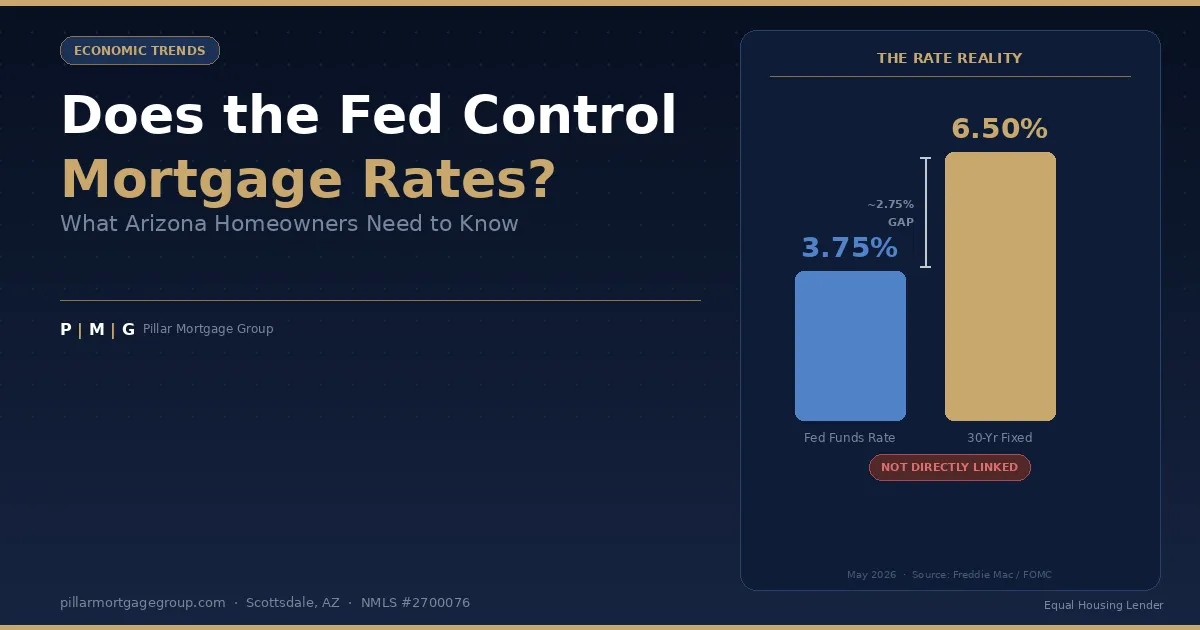
Here's the math that makes this clear: the Fed funds rate today sits at 3.5–3.75%. If the federal funds rate directly set mortgage rates, a 30-year fixed in Arizona would be somewhere around 3.5–3.75%. Instead, the average 30-year fixed rate in Arizona is approximately 6.50% as of May 19, 2026. That near-3-point gap is your proof that the Fed and your mortgage rate are not the same thing — and are not governed by the same forces.
The Federal Reserve Bank of Atlanta has formally studied this relationship and published research titled "Not Joined at the Hip: The Relationship Between the Fed Funds Rate and Mortgage Rates." Their conclusion: mortgage rates and short-term interest rates can — and regularly do — move in opposite directions.
What Actually Moves Mortgage Rates
If it's not the Fed directly, what actually drives your 30-year fixed rate up or down? Several forces, all of which play out in the bond market:
- Inflation data (CPI reports) — This is the single biggest driver right now. When inflation rises, bond investors demand higher yields to protect the purchasing power of their returns. Higher Treasury yields = higher mortgage rates. When inflation cools, the reverse happens.
- Jobs reports (Non-Farm Payrolls) — A strong jobs report signals economic strength, which often pushes yields — and mortgage rates — higher. A weak report can do the opposite.
- Bond market demand — When investors globally flee to safety (U.S. Treasuries are considered the world's safest asset), demand drives Treasury prices up and yields down, which typically pulls mortgage rates lower with them.
- Geopolitical events — Trade tensions, conflict, or financial instability anywhere in the world can drive a rush into Treasury bonds, compressing yields and potentially easing mortgage rates. In the current environment, geopolitics may actually be a bigger near-term driver of Arizona mortgage rates than any Fed decision.
- The "spread" between Treasuries and mortgage-backed securities — Lenders add a premium above the 10-year yield based on their own risk assessment and market conditions. When this spread widens (as it did significantly in 2022–2023), mortgage rates rise independent of what the Fed does.
One more important nuance: mortgage rates move on expectations, not announcements. By the time the Fed makes a decision, the bond market has already been pricing in that outcome for weeks or months. That's why you'll often see mortgage rates barely move — or even move opposite to what you'd expect — on the day of a Fed meeting. The market already knew it was coming.
What This Means for Arizona Buyers and Homeowners Right Now
As of mid-May 2026, the 30-year fixed rate in Arizona is hovering around 6.50% — notably down from 6.88% just a week ago. That move had nothing to do with the Fed, which didn't meet in May. It was driven by bond market dynamics and shifting economic data.
Forecasters broadly expect mortgage rates to settle in the 5.9–6.5% range by year-end 2026 — but that projection depends far more on CPI reports, the bond market, and geopolitical stability than on whether the Fed cuts rates. If inflation continues to ease and bond investors regain confidence, Arizona mortgage rates could drift lower even if the Fed never touches the federal funds rate again this year.
The practical takeaway for Phoenix and Scottsdale homebuyers: stop waiting for a Fed cut to unlock lower mortgage rates. They may come independently — or they may not come at all, regardless of what the Fed does. Our team at Pillar Mortgage Group can help you understand today's rate environment and structure the right loan for your situation, whether rates cooperate or not. You can also browse current listings in the Phoenix-Scottsdale area at Arizona Luxury Property Search to see what's available right now.
Frequently Asked Questions
Does the Fed control mortgage rates?
No — not directly. The Federal Reserve sets the federal funds rate, which governs overnight bank-to-bank lending. Mortgage rates are priced off the 10-year U.S. Treasury yield, which is set by bond market supply and demand — a completely different mechanism. The two can and regularly do move in different directions.
Will mortgage rates go down in 2026 if the Fed cuts rates?
Not necessarily. When the Fed cut rates in late 2024 and 2025, mortgage rates actually rose during parts of that period because bond market conditions were moving independently. Mortgage rates in 2026 will be shaped primarily by inflation data, bond market demand, and geopolitical factors — not by Fed decisions alone. Most forecasters project rates in the 5.9–6.5% range by year-end, but that's contingent on multiple factors beyond the Fed.
What is the difference between the Fed funds rate and mortgage rates?
The federal funds rate (currently 3.5–3.75%) is the rate banks charge each other for overnight loans — it's a short-term benchmark. The 30-year fixed mortgage rate (~6.50% in Arizona as of May 2026) is priced off the 10-year Treasury yield plus a spread. The nearly 3-percentage-point gap between them is a perfect illustration of how different the two rates actually are.
What should I actually watch to predict where mortgage rates are going?
Focus on: monthly CPI (Consumer Price Index) inflation reports, the monthly Non-Farm Payrolls jobs report, the 10-year Treasury yield on any given day, and major geopolitical or financial market events. These are the actual levers that move 30-year fixed mortgage rates — not Fed meeting outcomes.
Do HELOCs and adjustable-rate mortgages follow the Fed rate?
Yes — much more closely than fixed-rate mortgages do. HELOCs and ARMs are tied to short-term benchmarks like the prime rate or SOFR, which do respond directly to Fed decisions. If you're considering a HELOC or an ARM in Arizona, Fed policy is highly relevant to your interest rate. For 30-year fixed buyers, it's largely a distraction.
Ready to Make Your Move?
Pillar Mortgage Group is a Scottsdale-based mortgage brokerage specializing in helping Arizona buyers, investors, and homeowners navigate every type of loan scenario — from conventional and FHA to DSCR, bank statement loans, and refinances. Ready to start your search? Browse current listings at Arizona Luxury Property Search.
Visit pillarmortgagegroup.com to learn more or get started today.
Want to understand how today's market shifts affect your mortgage?
📅 Schedule a Free ConsultationAbout Pillar Mortgage Group
Pillar Mortgage Group, LLC is a licensed mortgage brokerage based in Scottsdale, AZ.
Company NMLS# 2700076 | Arizona License MB-2009671 | Equal Housing Lender.
9089 E Bahia Dr 101A, Scottsdale, AZ 85260
This content is for informational and educational purposes only and does not constitute financial, legal, or tax advice. Mortgage rates, loan programs, and market conditions are subject to change without notice. Not a commitment to lend. All loans subject to credit approval, property qualification, and applicable underwriting guidelines. Third-party market data referenced in this article is sourced from publicly available information. Pillar Mortgage Group does not guarantee the accuracy or completeness of third-party data. Pillar Mortgage Group conducts business in accordance with the Fair Housing Act and the Equal Credit Opportunity Act.
